Wednesday, 21 February 2018

The Aeronaut's Windlass


Best selling Author Jim Butcher has turned his hand to YA. The Aeronaut's Windlass is dominated by  superb female characters, and he's ventured into the steam punk genre. Who would have thought? This book is gripping from start to finish.
If you like Jim Butcher (I'll admit I'm a fan of his adult series Dresden files), or you love steam punk, you are going to love this. It's a change from his usual style using the 3rd person narrative but that gives him lots of scope new possibilities as a writer. Soar through the air on a exhilarating ride!
Best of all, once you fall in love with the characters you don't have to leave them forever. This is only the first in the 'Cinder Spires' series.

Share:

Call to Abandon the Diagnosis of all Mental Health Problems

The release of the Power Threat and Meaning Framework in January 2018 was momentous. Hmm, I hear you responding. Why should I get excited about about the release of a new Psychological framework?

Okay, I’ll admit most psychological models won’t have the majority of the public jumping in the aisles but the implications of this one are profound. It calls for the complete and immediate abandonment of diagnosing mental health problems. Yep. You read that correctly. Sound’s like they’ve lost the plot right? I promise all my blogs won't be as heavy as this one, but I have to be serious sometimes! To understand where this model is coming from, I’ll need to do a little contextual explaining. Please bear with me.

In 1955, The Diagnostic and Statistical Manual of Mental Disorders was published. For the first time Doctors could categorise the ‘symptoms’ their patients were experiencing into illnesses with their own names. Back then, many of these symptoms were labelled ‘reactions’ or psychotic reactions, i.e. there was an acknowledgement that these ‘symptoms’ were in response to something that had happened to people. We’ve lost that connection nowadays. Nowadays you’re just sick. There’s something wrong with you if you’ve been diagnosed with a mental health problem. Not only that, but some diagnoses such schizophrenia have also acquired the reputation of dangerousness. Psychologists have always had a problem with this. Lots of our models are on continuums, that is, people vary in where there are on a scale of any given trait. People move up and down multiple scales over the course of a lifetime. In no other field are human beings considered simple. But that’s what the diagnosing of mental illness attempts to do. Simplify human experience down to presence or absence of a disease. It’s categorical - you’re sick or you're not.

This leaves those of us who work for the NHS with a problem. I suspect most practitioners accept that diagnoses are not perfect, and see them as a useful shorthand to describe what is going on for people. They choose to ignore how much damage this labelling people as ‘other’ is doing to both people as individuals and to society. All of society’s ills cannot be cured by medics, if we label reactions to incredibly difficult life experiences as illness then we cause a situation when we expect precisely that. It’s not a coincidence that Britain is issuing more prescriptions for depression than ever before in it’s history. The more the illness model is entrenched the more demand there will be on the NHS.

Throughout my career I’ve struggled with this. As a clinical psychologist I was trained by the NHS for the NHS, and I have to work within this imperfect system. It’s all very well for psychology and our social work colleagues to grumble about labelling, but if we are not offering an viable alternative, then we are just seen as fluffy or ‘unscientific’, (both of which I have been called when arguing against diagnosis.) For the first time we now have an alternative. The power threat and meaning framework offers a new way to view ‘symptoms’. They are seen as intelligible responses to our previous experience. This means mental health professionals should never be asking ‘What is wrong with you?’ but rather ‘What has happened to you?’

The Global Mental Health Movement are exporting a diagnostic model across our planet. In theory, I would support their cause. Alleviating the suffering of those in distress is a noble aim. Unfortunately, they are offering treatment based on diagnosis as the only way to help people with emotional troubles. The cultural difficulties with this are immense, for example shamans regularly hear voices and are feted for it. The very people who have been revered in their culture for generations are being told they are sick as they hear things other people don’t. How can educated people not see how absurd this is?

I was lucky enough to be at the friends Meeting House in London for the official unveiling of this framework. Surrounded by representatives from Psychology, experts by experience (those who have suffered the ignominy of being labelled with a diagnosis) and other mental health professionals. Everyone I spoke to threw themselves behind this model. That is not the norm for a conference. I did not hear one word of dissent. The model is new, it needs a lot of tweaking but the effort to bring together research from so many different fields is only to be admired. It was a privilege to be in a room with filled with such hope. It’s an uphill battle, taking on society, but everyone was up for it!

If you’re not convinced that diagnosis is a strange way to go about things reflect on this. If you were gay forty odd years back you would have been given a diagnosis by DSM. You were sick, deviant and needed to be made well again. This clearly demonstrates that the construct of illness and disorder, ‘mental’ or otherwise is purely a social one. Shifts in the concept and nature of disorder reflect wider social, political and economic forces more than scientific advancement. And don’t get me started on Asperger’s. That doesn’t even exist as a diagnosis anymore, confusing individuals, their families and society alike. How can a person ‘have’ something one day, and it be abolished the next?

It’s time we all started rejecting this powerful story of individual weakness/deficit and medical illness. If you take a moment to think about this, really think, you’ll see that there are massive numbers of vested interests which serve to preserve the medical illness model. Not only personal interests but family, organisational, professional, community, economic, and political.

The whole of society is contributing to maintain this fiction. For too long, these interests have deprived people of a socially shared framework which they can use to make sense of their own experiences. It’s time for change.

If you are interested in reading more about power threat and meaning, you can access the link to the British Psychological Societies Division of Clinical Psychology below:

You can read the full Power Threat Meaning Framework here, or a shorter overview.


Share:

Is it Okay?


I often get asked my opinion as a psychologist on suitable literature for children. Most things are okay. There are very few topics that are taboo. You can be sure that if it's in the children's or YA section, there will have been a lot of thought put in as to why, by the publisher.

It's no coincidence that one of the most popular European Fairy tales introduces us to a wolf that eats grandmothers and little girls. Kids love to be frightened in their imagination. They understand the difference between a story and real life.

I would be avidly glued to Dr. Who as a child, and only rarely have to hide behind the sofa. However, I had a recurring nightmare about a minotaur that I'd seen in a cartoon, that was pitched at an audience much younger than Dr. Who. I had to sleep with the light on for weeks because of that dratted minotaur. It's impossible to predict just what your child might find scary. Obviously, I've chosen never read anything about minotaurs to mine but one of them was terrified by a Dr. Who episode that was the least scary one I'd ever seen! It's no good censoring literature for frighteners, because you'd end up binning the lot. One child's Pennywise, is another child's favourite cuddly toy.

So, allow them to read to their hearts content, but be sensible. Age ratings and warnings are there for a reason. Take note of them, and if your kids tell you they've found something scary, talk to them about it. It's often through facing their fears that they are able to understand them.
Thinking about it, maybe I should be reading about Minotaurs myself.

One of my friends told me that she would never let her children read about anything with sexual abuse in. I believe this is totally wrong. If topics are off limits, you end up with a culture of secrecy. Of course, some literature aimed at grown-ups will be inappropriate but there are some lovely books aimed at very young children that deal with this topic.

A particular favourite is 'Mousie' a picture book written by a clinical psychologist who experienced abuse herself. I've read it to my children without any hesitation. It was originally written as a support to help those children who practitioners suspect may have been abused, but personally, I feel it should have a wider audience. Children should be always be encouraged to talk about anything that is bothering them.

If you are interested in reading this story you can follow this link: Visit Amazon's Khadj Rouf Page


Share:

Wednesday, 14 February 2018

Little People, BIG DREAMS


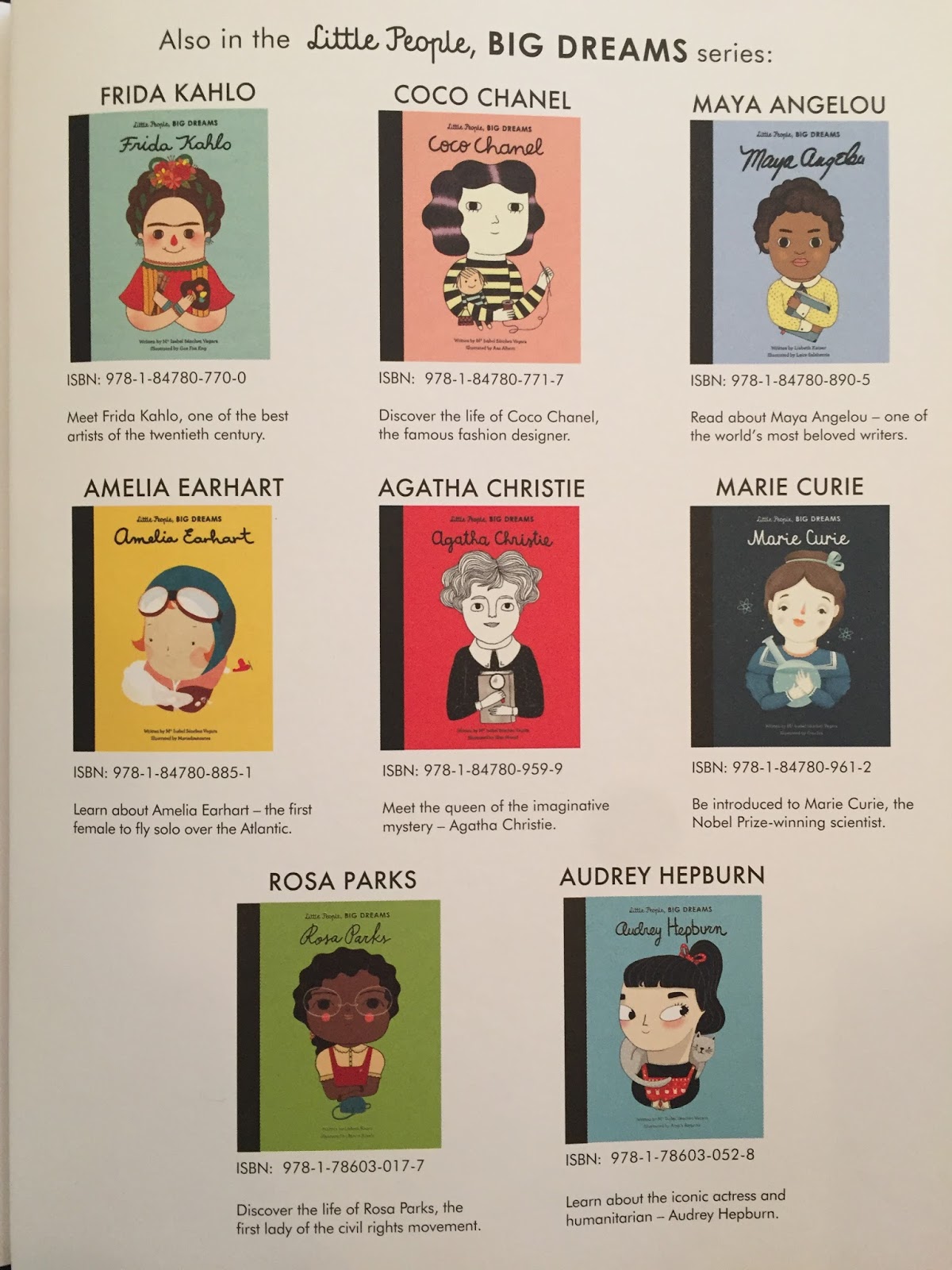
If I’m entirely honest, I bought these books for myself. Little People, BIG DREAMS is a series of books about inspirational women from history. They’re beautifully illustrated and written in simple but truthful language, and tell the stories of amazing, full lives, all of which left a lasting mark on the world.

I can remember when I was maybe six or seven, being obsessed with a series of non-fiction books on the various English monarchs. I think it was something to do with them being real people, living real lives, rather than the sentient animals or mischievous children who populated the majority of my reading material.

But even then, I was well-aware that most of my beloved monarchs were men. In fact, most of the big players in history tended to be of the male persuasion—if the history books are to be believed. In 2015, Slate surveyed 614 US popular history titles to reveal that 76% were written by men, mostly about men. The UK is (at least, it was in 2015) apparently much the same. Serious history, serious men, war, politics, Nazis, grrrrr, men. (Slate link here).

Thankfully, recent years have seen more interest in social and cultural history, and women are getting more of a look-in. But "uncle books", as the Slate article calls them, still seem to dominate, if the tables at Waterstones are anything to go by.

So since having a daughter, I’ve been working on diversity—be it gender, race, lifestyle, opinion, etc.—in our kids’ non-fiction book collection. When my daughter starts reading for herself, my hope is that she’ll be surrounded by books about all manner of different people and she’ll not think to herself ‘hmmm, why was it only men who got to do meaningful stuff?’.

Except…at three-and-a-half, she already loves the Little People, BIG DREAMS books, maybe for the same reasons I loved those monarchs, who knows? What I do know is that she engages with the stories far more than any of the children’s books she owns—to the point that she’s drawn extra pages for the books depicting some of the scenes which the writers chose to not dwell on. Poor Pierre Curie being run over by a horse and cart, for example (this would be darker if she hadn’t included an ambulance to save him, thus triggering a whole alternative timeline that may well change the world as we know it).

We love the Marie Curie, Emmeline Pankhurst, Maya Angelou, and Frida Kahlo books. We still need to buy Amelia Earhart, Coco Chanel, Agatha Christie, Rosa Parks, and Audrey Hepburn. It shouldn’t feel transgressive to buy a series of books featuring only women, but for me it still does—which is why I think we need books like this in the first place.


Check out the fonts and design - so pretty!


And while we're at it, these Little FEMINIST cards are beautiful, even if my preschooler does insist on rolling in them rather than playing Snap.

Share:

Sunday, 11 February 2018

Women in Science Day. February 11th. Who knew?

I've always been a total sucker for a celebration. Any excuse to make a day more exciting for the kids and I'm there. This half-term we will be proudly flipping pancakes, throwing around love hearts and transitioning to the Year of the Dog. Now it seems, I get a whole new one. Not sure how I missed this the last couple of years but I've made sure to sure to foist a new celebration on my kids today.  We've been conducting various experiments whilst learning about some of our female greats... If you're interested in finding out more, why not look here: http://womeninscienceday.org
Share:

Tuesday, 6 February 2018

Gender Imbalance in Children's books


Back in 2011, A female professor reviewed over 6,000 children's books published from 1900-2000, and found a massive gender imbalance. Many more books had male characters than female ones. By 1990 this discrepancy was shrinking, but in the case of animal protagonists the gap was still huge. If you're an author writing about animals stars, you are still far more likely to make that animal male. In this way, children are inadvertently encouraged to accept the invisibility/importance of women and a patriarchal gender system is reinforced. It's worth thinking about when we write. Hmm.. I'm guiltily remembering my male spider, in my last book.

More importantly though, it's not just those who star in books that matter but how females are represented when they do appear. Here, I can heave a huge sigh of relief. There's lots of great modern literature in which the Princesses rescue themselves, thank you very much (or even rescue the hapless Prince). There are books in which Dad is the homemaker, and can be found ironing, cooking and up to all sorts of domestic duties. Search them out people!

Kat is giving us a helping hand by reviewing children's books that tell us stories of great women. Make sure you check out her blogs.

It's apposite to talk about this today, as (just in case you've missed all the media coverage,) it's been a hundred years since women obtained the right to vote in Britain (6.2.1918). And okay, it wasn't all of them but it was getting there...

A lot has changed since then. I've been lucky enough to have been born in a country and an era when I can have as many kids as I want, and have whatever career I want. But there is still a long way to go to achieve true equality. All of us have a responsibility to help every human being have the same rights as any other. As writers, we are in a perfect position to address imbalance, and as readers we can ensure we think carefully about what inadvertent messages our bookshelves might convey to our children.

And for all those out there who have a violent hatred of 'social justice warriors' (you know who you are) I'm not suggesting you throw away all the brilliant literature you may have that isn't PC in 2018. Censoring literature that was of its time and culture will only draw us closer to newspeak. I'm simply suggesting you make sure that isn't the only thing your children are exposed to.


Share:

Sunday, 28 January 2018

Psychologist Tips to Encourage Reluctant Readers

One of my children has a specific language impairment. Watching him read is painful. He's never been able to relax, and the level of concentration required is about as much as it would take me to understand a page of calculations in an astrophysicists notebook. Worse, he lives with a family of bibliophiles. All of us love it, or more to the point find it EASY. He loves stories too, and always has done, he just finds the act of getting them from the page to his head laborious. I've thought long and hard about how to encourage him, and looked at other's recommendations. Here's a list of tips that I've found helpful. I hope at least one strikes a cord with your reluctant readers.

Make it fun
Right from the moment you decide to read together, make the thought of books exciting. If you're lucky enough to have lots of books to read in your house, let them chose the story, maybe even a play a game as you search for it. Then they'll feel in control. If you're off to the library, build the trip up into a fun event. Arrange a playdate with a friend where they lend their favourite books to each other. Anything you can do, no matter how little to reinforce a love of books, is to be encouraged.

Make it a regular part of your day
Psychologists love their routines. There's stacks of research to show if you want to change behaviour you have to make a plan. Build reading into your family's routine, it doesn't matter when, bed-time, after tea, first thing in the morning. Whatever works for you as a family. Your child will love the one to one attention. If reading has already become a battleground due to enforced homework, and you're thinking, no they won't! Think creatively. Take it back to basics, what can you do to make it enjoyable again? If you need a sticker chart, or a promise of console time then do that. Practically any kind of reward is good, the best is a promise of more time with you. (but please don't use food, that could set them up with a lifetime of trouble).

Any reading is great
No matter what your child chooses to read, encourage them. Graphic novel and comics are still reading. My Mum was told off by her teacher friends for taking out a subscriptions to a comics for my brother and I. Even as I child I wondered what their problem was? I was choosing to read wasn't I? Not watch telly? A child's choice to read, now has to compete against the megaliths of Playstation, Nintendo and Microsoft. Who cares if there's a lot of pictures with the text?

Use technology
Use social media for inspiration or ideas. Publishers make a splash when new books are released, and deliberately try to generate excitement. Let their marketing do your work for you. 
Sign up to newsletters and read blogs like this one!
Remember not all screen use is anti-reading. Some games use a lot of text and can be a sly way to get them reading independently everyday.
If your child has a tablet, get them to download books they'd be interested in reading to it. Some children much prefer reading from a screen.

Talk to your Librarian
Libraries in Britain have a whole data-base for children who are reluctant to read or have a specific challenge like dyslexia. Who Knew? (I hope this is worldwide endeavour but I don't have first-hand knowledge of other's countries libraries). Ask for help and your child may discover a whole new world of stories that are easily accessible.

Share the joy
Never be afraid to enthuse about books to your kid. Tell them what you loved as a child. Or even better, read your favourites to them. Inspired by your passion, they may well love them too. If it's not their cup of tea, don't be despondent, they will remember your enthusiasm, and want to search for their own stories that fire their imagination.

Get down with the kids
Story-time doesn't need to be traditional - it can be downright silly if you want. Read in a treehouse, hanging upside down. Set a scene, if you're a Gruffalo in a woods, make those woods, get in the garden or create one in your house. Use silly voices whenever possible. Get right in character yourself. You can even use props. Ask your child to become a character, anything that makes it interactive. My favourite tip is to change the name of a character to your child's name. There's nothing like it to get their attention!

Never ever get cross with them
That is, in relation to reading. I don't live in a fantasy bubble land where parents never get cross with children in general. No matter how frustrated you are by their reluctance to read try not to show it. If children associate reading time with conflict it will make them even more reluctant and undo all your good work.

Share: