Showing posts with label Kat. Show all posts

Thursday, 12 April 2018

Once Upon a Star


Once Upon a Star by James Carter and Mar Hernandez calls itself 'a poetic journey through space' and I love it.

A picture book written in narrative verse, all about how the universe formed and our world came to be? Beautiful artwork and eye-pleasing graphics? The Big Bang in a book for pre-schoolers? Awesome.


It's the illustrations that made me buy this book. I've always had a real thing for non-fiction artwork and am so happy that recent years have seen so many beautiful and educational books make it onto the shelves.


Share:

Tuesday, 13 March 2018

Pinterest for Writers

I thought I would post some of my favourite writing tools here. One of my top 10 is Pinterest. For the uninitiated, it's basically an online cork board where you can pin images and articles that take your fancy. You can choose if you want to share your boards with others, a select few, or keep them private.

I use Pinterest for my setting research and have one for all of my novels (as well as every room of my house). You can either search Pinterest itself for images you like, find pictures via Google or wherever and add them yourself, or pick from the recommendations based on your viewing history (my current recs are a combination of beautiful staircases, educational activities for kids and - bizarrely - sexy clowns). It's really simple and a great way of gathering images and bookmarking research articles all in one place.

In a previous post, I mentioned a book I wrote inspired by Ballard's A Drowned World. This is a Pinterest board I made when imagining the setting, plus there's a screenshot below.


As an aside, Pinterest have introduced a newish tool in which you can take a smartphone picture of anything and it will find you similar images online. I just tested in on my cat and found his doppelgängers from around the world. It will probably prove more useful in other, yet to be discovered, ways.
Share:

Flooded Cities and Future Worlds

Climate change is redrawing the map of the world. When UN climate change experts met up at the end of last year, it was to discuss a new three-degree future in which rising sea-levels will wipe numerous cities from existence. So today's writing inspiration is of the flooded city variety, courtesy of some 1960s' science fiction and our shortsighted habit of polluting our poor planet.

J.G.Ballard's A Drowned World is one of my favourite books. Considering he wrote it back in 1962, it is scarily prophetic when it comes to the sweltering tropics of what used to be London, turned into a watery wasteland populated by reptiles and giant insects.
"Already many of the surrounding buildings had disappeared beneath the proliferating vegetation. Huge club mosses and calamites blotted out the white rectangular faces, shading the lizards in their window lairs. Beyond the lagoon, the endless tides of silt had begun to accumulate into enormous glittering banks, here and there overtopping the shoreline like the immense tippings of some distant goldmine."
It both scares and humbles me to imagine that Ballard's vision may, one day, come true. Our current global climate change interventions had aimed at keeping global warming to a toasty 2C above pre-industrial levels. Only, the latest projections suggest we are on track for a 3.2C and that means a whole lot of water will be coming our way thanks to melting ice-caps. The areas at risk of flooding are currently home to 275 million people, most of them living in Asia.

Projections by Surging Seas show how the coastal regions of the world are likely to change. Large areas of London are among those at risk, in scenes reminiscent of A Drowned World.

A 3-degree increase in global temperature will see much of London flooded

A few years back, artists were asked to imagine what London could look like in 2100. Some of the scenarios they envisioned saw landmarks half-submerged, turning London into a city reminiscent of Venice.


There's more on the three-degree world in this Guardian article here.

*

And here's some book recommendations featuring flooded cities. I will add to the list if anyone wants to comment below with their favourites.

The Drowned World by J.G.Ballard follows just a couple of characters as they regress through the aeons as nature reclaims an abandoned London. “The trouble with you people is that you've been here for thirty million years and your perspectives are all wrong. You miss so much of the transitory beauty of life,” says one of the characters.

New York 2140 by Kim Stanley Robinson features a flooded version of New York, so I had to include it on the list (even if the level of the sea level rise is a bit extreme). The bad guy here is capitalism and parts of Manhattan are nicknamed SuperVenice, which is brilliant.

Exodus by Julie Bertagna is the first YA on my list. Rising sea levels, a sky city and the Netherworld—a flooded Glasgow cast in shadow by the sky city overhead. My last novel featured a similar shadowy undercity, so finding this book was both exciting and distressing that there are no new ideas. 

Floodland by Marcus Sedgwick is a middle grade novel set in a flooded version of England in which Norwich is now an island and the main character has misplaced their parents.

The Sea and Summer by George Turner has been compared to The Drowned World with its watery vision of the future. It was Sci-Fi back when it was written; now it feels more like a warning.

Odds Against Tomorrow by Nathaniel Rich has great cover art and a lot of maths, plus it manages to be funny in the face of a city's annihilation. (I'm in the process of reading this one, and love it so far).


Share:

Monday, 12 March 2018

Glamorous Decay as a Lifestyle

Interesting read for writer types: The fantasy of the writer's lifestyle

I do love the whole glamorous decay trope when it comes to writing, both on and off the page. Sadly, I know of no one whose writer's lifestyle in anyway matches up with an Anthropologie catalogue. Maybe I need to remind myself that it's possible to be a 'real writer' even if you don't feel like one.

I liked this quote from the article:

There is no writer’s lifestyle; your lifestyle is determined by what that other work is. I’m baffled when I come across interviews where writers laughingly allude to the solitude, say, or the introspection of the novelist’s life. No matter how solitary or introspective you are while you’re writing novels, you are likely spending many more hours each week at another job, or commuting, or raising kids, or trying to keep your house clean.
Anyway, somewhat fittingly, I had to run off to collect my daughter half way through writing this. Now that I am back, I thought I would share these Anthropologie mugs as a potential gift for the writer in your life:


And their books and stationary section isn't half-bad either. 

(p.s. I'm just sharing products I like here, not trying to trick you into clicking on affiliate links). 
Share:

Wednesday, 14 February 2018

Little People, BIG DREAMS


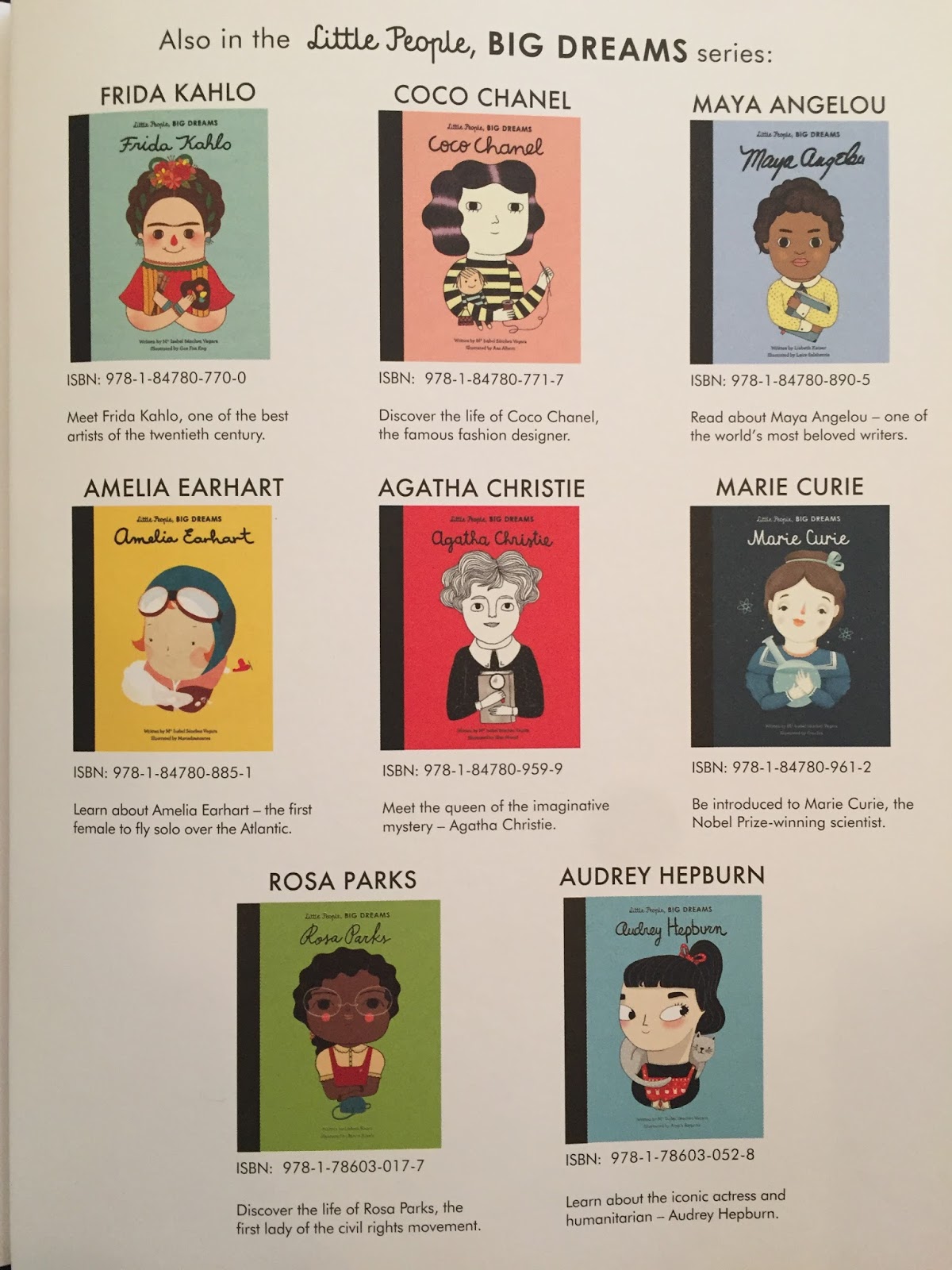
If I’m entirely honest, I bought these books for myself. Little People, BIG DREAMS is a series of books about inspirational women from history. They’re beautifully illustrated and written in simple but truthful language, and tell the stories of amazing, full lives, all of which left a lasting mark on the world.

I can remember when I was maybe six or seven, being obsessed with a series of non-fiction books on the various English monarchs. I think it was something to do with them being real people, living real lives, rather than the sentient animals or mischievous children who populated the majority of my reading material.

But even then, I was well-aware that most of my beloved monarchs were men. In fact, most of the big players in history tended to be of the male persuasion—if the history books are to be believed. In 2015, Slate surveyed 614 US popular history titles to reveal that 76% were written by men, mostly about men. The UK is (at least, it was in 2015) apparently much the same. Serious history, serious men, war, politics, Nazis, grrrrr, men. (Slate link here).

Thankfully, recent years have seen more interest in social and cultural history, and women are getting more of a look-in. But "uncle books", as the Slate article calls them, still seem to dominate, if the tables at Waterstones are anything to go by.

So since having a daughter, I’ve been working on diversity—be it gender, race, lifestyle, opinion, etc.—in our kids’ non-fiction book collection. When my daughter starts reading for herself, my hope is that she’ll be surrounded by books about all manner of different people and she’ll not think to herself ‘hmmm, why was it only men who got to do meaningful stuff?’.

Except…at three-and-a-half, she already loves the Little People, BIG DREAMS books, maybe for the same reasons I loved those monarchs, who knows? What I do know is that she engages with the stories far more than any of the children’s books she owns—to the point that she’s drawn extra pages for the books depicting some of the scenes which the writers chose to not dwell on. Poor Pierre Curie being run over by a horse and cart, for example (this would be darker if she hadn’t included an ambulance to save him, thus triggering a whole alternative timeline that may well change the world as we know it).

We love the Marie Curie, Emmeline Pankhurst, Maya Angelou, and Frida Kahlo books. We still need to buy Amelia Earhart, Coco Chanel, Agatha Christie, Rosa Parks, and Audrey Hepburn. It shouldn’t feel transgressive to buy a series of books featuring only women, but for me it still does—which is why I think we need books like this in the first place.


Check out the fonts and design - so pretty!


And while we're at it, these Little FEMINIST cards are beautiful, even if my preschooler does insist on rolling in them rather than playing Snap.

Share:

Wednesday, 10 January 2018

Birnbeck Pier

Creepy abandoned buildings are one of my top sources of inspiration for new novels, so I thought I'd share one of my current favourites here.

At the entrance to Birnbeck Pier, a sign reads 'Death lies this way' which, if you ask me, sounds more like a challenge than a warning. Crumbling buildings, splintered wood, and tufts of grass sprouting from cracked concrete. It's everything I love in a setting, which is why my current work in progress is set on a derelict pier inspired by Birnbeck.

The only UK pier linking an island to the mainland, Birnbeck Pier started out as a Victorian theme park complete with water slides and steamship service. Closed in the 1970s, Birnbeck Pier is now an eerie wasteland. 

The image below is from a BBC article featuring some recent haunting images of the abandoned pier.


And this is a postcard from 1907 showing the pier in its heyday. Check out those fairground rides in the background. I found this image on the Friends of the Old Pier Society website - a non-profit organisation working to save Birnbeck pier.


And here's some drone footage taken by Jon Avery, complete with sinister soundtrack.


Share:

Tiny - The Invisible World of Microbes


Today's science for kids book recommendation is 'Tiny - The Invisible World of Microbes' by Nicola Davies and illustrated by Emily Sutton. The drawings are just lovely and illustrate the wonders of the microbial world perfectly. I've bought it for my 3 year old in the hope that one day in the distant future she'll find it on her bookshelf and fall in love with bacteria too.


Share:

Hidden Universes

I grew up staring out at the stars through my parents’ antique telescopes; marvelling at the tiny pinpricks of twinkling light and how, on a clear night, the Milky Way streaked across the sky. There are more than 100 billion stars in our galaxy, and more than 1,000 billion galaxies in the universe. How many of them, I used to ask myself, contained planets that were home to life like our own sphere of rock and ocean? It was always the potential for life that fascinated me, be it aliens with copper in their blood and sulphurous breath, or plants with red leaves and a taste for nickel. It felt like us humans were just a small part of something infinite in its vastness and, when I thought about it too hard, I became a lone comet tumbling through 46 billion light years of unknowable space.

When I grew tired of feeling small, I played with my parents’ brass microscopes, with their chipped lenses and seized knobs. At first it was leaves and hair and globules of pond water dripped directly onto the mirrors. I never saw very much but the hidden microscopic world fascinated me as much as looking out at the stars. I must have been about ten when the concept of bacteria first took hold of me. I think it was via a book mentioning Anton Van Leeuwenhoek who, back in the 17th century, had fashioned himself a homemade microscope to look at what he described as ‘wee animalcules’ and ‘cavorting beasties’ in fresh water. Of his animalcules, Leeuwenhoek said ‘ten thousand of these living creatures could scarce equal the bulk of a coarse sand grain.’ My view of the universe we live in stretched a little further, much like it had the moment when I’d realised the stars could all be someone else’s sun.

I grew up to become a microbiologist and not an astronomer. From a distance, both fields looked similar to me. Both saw the universe through lenses and mirrors, only one was looking up and the other down. I wanted to see the smallest living creatures in the world because, if we don’t even understand the extremes of life on our own planet, how can we hope to comprehend the breadth of life to be found throughout the rest of existence. The microbial universe was as beautiful as the night sky, with the way Bacillus subtilis formed fractal-like patterns across an agar plate or the rainbow hues of cyanobacteria radiating from the edges of the Yellowstone hot springs. Even the pathogenic species could be wondrous in the way that, wherever you look, life has found a way and a home.

---

Kathryn is an ex-research microbiologist-turned-science writer, YA author and parent of one mischievous three year old. She blogs here about the weird and wonderful world around us - from finding beauty and writing inspiration in unlikely places, to the representation of science in kids literature. And anything else that captures her imagination.
Share: